
Nozzle Inventory Management: The $20,000 Saving Hiding in Your Spare Parts Cabinet
Nozzle Inventory Management: The $20,000 Saving Hiding in Your Spare Parts Cabinet
Every SMT factory has a Nozzle drawer. It sits near the maintenance bench, inside a labeled cabinet, or — more often — in a collection of unmarked plastic boxes stacked on a shelf. Inside are dozens, sometimes hundreds of Nozzle tips of varying lengths, bore sizes, and levels of wear. Some came with the original Pick and Place machines six years ago. Some were ordered as emergency replacements. A handful were included with a second-hand Feeder lot purchased from a broker.
Nobody manages the Nozzle drawer. It simply grows.
This article is about the gap between what that drawer costs your factory each year and what it should cost. The difference is not trivial — from field observations across Shenzhen EMS facilities, untracked Nozzle management can add several thousand to tens of thousands of dollars in hidden annual losses through scrap, downtime, emergency purchases, and lost throughput. The solution does not require a new machine purchase. It requires a system, a schedule, and one small tool you probably already own.

Panasonic SMT Nozzle — a common type found in mixed SMT line inventories
The Three Hidden Costs of an Untracked Nozzle Cabinet
The first cost is obsolescence. Every time a Pick and Place model is retired from production or sold to a secondary buyer, the dedicated Nozzle set for that machine becomes orphan inventory. Audits across multiple EMS facilities consistently show orphan Nozzles — tips that no longer match any active machine on the floor — sitting in spare parts drawers for years, counted at their original replacement value but worth nothing to production. The same pattern repeats with JUKI KE-series and FUJI NXT machine turnovers.
The second cost is compatibility drift. A factory that sources replacement Nozzles from multiple suppliers — OEM parts, compatible imports, generic lots from electronics markets — inevitably accumulates small variations in tip concentricity, internal bore finish, and vacuum port geometry. These variations may not cause constant failures, but they can increase intermittent pickup errors, placement offsets, and AOI false calls, especially on small passive components or fine-pitch devices. Most operators interpret this as Feeder vibration or PCB warpage and adjust the offset rather than checking the Nozzle.

FUJI Nozzle — compatibility variations across different Pick and Place models
The third cost is the absence of a preventive inspection schedule. Nozzle tips wear. The rubber sealing O-rings degrade from contact with flux residues, cleaning solvents, and repeated thermal cycles on the Pick and Place head. A worn Nozzle does not suddenly stop working. Its vacuum grip strength decays gradually. Instead of relying on a universal kPa value, factories should define replacement limits based on their own machine vacuum test data and defect history. Over two to four months, the CPH rate on that head may drop by 1-3% as the machine compensation cycles increase from reduced pickup reliability. No one notices because the decline is slow. But the cumulative throughput loss over a year across all 12 heads of a single machine adds up to measurable production time.
A Structured Approach to Nozzle Inventory
The fix is not expensive, but it requires discipline. Here is a four-element framework that operations teams in Shenzhen and the Pearl River Delta have implemented with results visible within one production month.
Element one: catalog by machine model. Every Nozzle in the drawer must be assigned to a specific machine type — JUKI KE-2050, FUJI NXT III, Yamaha YS12, or whatever your line configuration includes. Nozzles that cannot be matched to an active machine are flagged as surplus and either sold to a parts broker or sent to recycling. Southern Machinery's Nozzle store at nozzle.smthelp.com maintains compatibility tables for most major Pick and Place brands, which simplifies the matching process for mixed-vendor lines.
Element two: set economic min/max levels per Nozzle type. For a high-wear Nozzle (small bore sizes below 0.7 mm, or rubber-tipped variants for fragile components), keep four pieces per head: one active, one in cleaning rotation, one in storage, one as emergency buffer. For low-wear metal Nozzles above 1.0 mm bore, two pieces per head are sufficient. Track consumption over three months to validate these thresholds.
Element three: implement a cleaning interval. A Nozzle that runs through 50,000 placements without cleaning can lose 15-25% of its vacuum efficiency from flux residue buildup inside the bore. The S-6200 Nozzle Cleaning Machine from Southern Machinery addresses exactly this — it is a fully automatic, PLC-controlled unit that uses either water or solvent to clean multiple Nozzles simultaneously, with adjustable cycle parameters for different tip geometries. A machine of this class replaces 30 minutes of manual ultrasonic cleaning per shift and ensures consistent bore cleanliness across all heads.
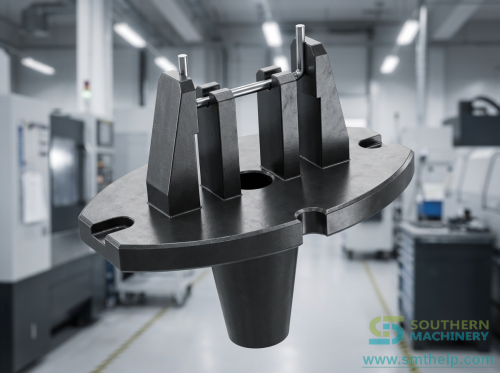
Customized JUKI Jumper Wire Nozzle — specialized tips require dedicated inventory tracking
Element four: scheduled inspection. As a starting point, set inspection intervals by placement count: inspect rubber O-rings and small-bore Nozzles every 80,000-120,000 placements, and larger metal Nozzles every 150,000-200,000 placements. Then adjust the replacement interval based on actual pickup error rate, vacuum test results, and visual inspection. This eliminates the gradual throughput decay problem entirely.
When the Framework Applies — and When It Does Not
This approach works best for factories running a mixed-age machine park with three or more Pick and Place models. The obsolescence risk rises sharply with line diversity. A factory with a single model of machine and two Nozzle types — for example, a dedicated LED line using only 1.2 mm round Nozzles — will see smaller savings because the inventory is small and well-understood already.
For most EMS and OEM factories in the appliance, power supply, and automotive component sectors, the diversity is high enough that the process pays for itself in the first quarter. The time investment is roughly four hours for the initial audit (counting, testing, matching to machines) and one hour per month for ongoing maintenance.
The retrofit question also deserves mention. Factories that already own ultrasonic cleaners can integrate them into the structured program without buying new equipment. Southern Machinery's after-sales services include Nozzle repair (3-5 day lead time, 3-6 month warranty on repaired parts) and custom Nozzle fabrication from OEM part numbers or 3D models — both services are useful when the audit identifies a broken tip that needs replacement but the OEM batch price makes a single-piece order uneconomical.
The Quick Nozzle Cabinet Check
A quick check that any maintenance manager can run during a shift change can reveal whether a deeper audit is needed.
Gather Nozzle containers from the spare parts cabinet. Count the total pieces and record them by type. For each group of identical Nozzles, check two parameters: (1) Is the machine model that uses this Nozzle still in active production? (2) Pick five Nozzles at random and inspect the tip opening under 10x magnification — signs of oval wear, chipped edges, or discolored rubber.
Calculate the surplus value: multiply orphan Nozzles by their replacement cost. For a full audit covering a two-line factory, allow several hours — it often identifies obsolete stock, over-purchased items, and high-wear Nozzle types that need better control.
Free Resource: Audit WorksheetDownload Nozzle Cabinet Audit Worksheet →
For a factory running six Pick and Place machines across two lines, the full audit typically recovers thousands of dollars in usable Nozzle inventory and eliminates unplanned changeover stops caused by vacuum failures.