
The True Cost of Manual Through-Hole Assembly: When Does Automation Start Paying Back?
The True Cost of Manual Through-Hole Assembly: When Does Automation Start Paying Back?
Every plant manager responsible for a mixed SMT/THT line has run the calculation at some point. "Should I replace this manual insertion station with an auto insertion machine?" The answer usually comes down to one number: how many operators can I redeploy?
But in my experience visiting EMS factories across the Pearl River Delta, that single question misses most of the picture. The real decision framework is broader, and the payback period is often shorter than managers assume — when the full cost of manual assembly is counted.
What Manual THT Assembly Actually Costs
Direct labor is the obvious one. A 10-person manual THT line running two shifts represents roughly 20 operators. At typical Shenzhen factory rates, that is between RMB 600,000 and 800,000 per year in salary alone, before social insurance, housing fund, and meal subsidies.
But there are four other cost lines that rarely make it into the calculation.
Rework. Manual insertion defect rates typically run between 2% and 5%, depending on component mix and operator experience. For a line producing 2,000 boards per shift, that means 40 to 100 boards requiring touch-up after Wave Soldering. Each rework cycle costs replacement components, repair technician time, and throughput loss. At conservative estimates, rework adds 15-25% to the effective cost of manual assembly.
Training and turnover. The EMS industry in the PRD region sees operator turnover of 30-50% annually. A new operator takes 2-4 weeks to reach full speed and acceptable quality. During that ramp-up period, defect rates can double. Across 5-10 new hires per year per line, this hidden cost is significant.
Line balancing loss. Manual stations operate at different speeds depending on component type, tape condition, and operator fatigue. A 10-station line is only as fast as its slowest station. Real-world throughput on a mixed manual line rarely exceeds 65-75% of theoretical capacity. This means fixed overhead — Wave Soldering machine, floor space, facility costs — is spread across fewer good boards.
Floor space. A 10-station manual insertion line with operator benches, component bins, and material staging occupies roughly 40-60 square meters. The same throughput from two auto insertion machines plus one operator fits in under 15 square meters.
How Auto Insertion Changes the Economics
Modern auto insertion machines address all five cost lines simultaneously.
The S4000 Axial Auto Insertion Machine, for instance, processes axial components — resistors, diodes, jumper wires — at 20,000 CPH. That is roughly 25-30 times the speed of a single manual operator. A machine such as the S-3010B Radial Insertion Machine handles radial components — capacitors, transistors, LEDs — at 13,000 CPH actual throughput, with 360-degree insertion direction and vision-guided coordinate correction.
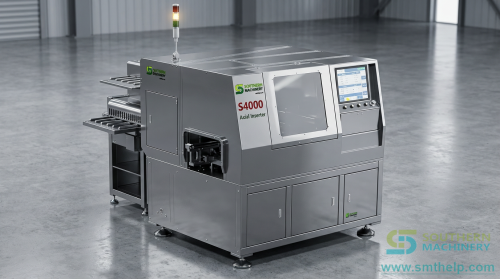
S4000 Axial Insertion Machine — 20,000 CPH throughput
One operator can manage up to four machines. This changes the staffing equation from 10 operators per shift to 1-2 operators overseeing the entire THT section.
Defect rates drop below 0.5%, because the insertion head uses force detection to verify each component seats correctly, and the clinch mechanism bends leads to a precise angle of 10-35 degrees that holds the component firmly through the Wave Soldering process.
And the quality is consistent from the first board of the morning shift to the last board of the night shift. No fatigue curve, no Monday-morning slump.
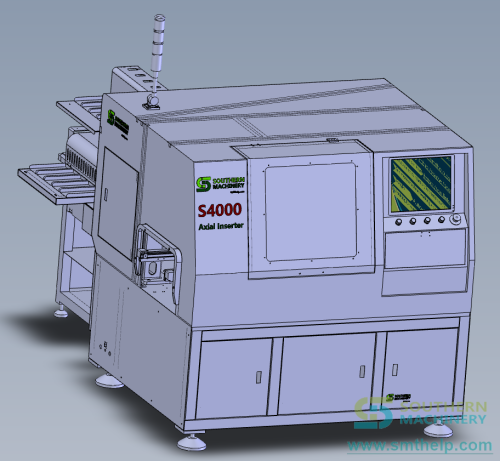
S4000 with 10 axial Feeders — high-volume production configuration
The Payback Decision Framework
So when does automation pay back?
A factory running 10+ manual THT operators across two shifts, with board volumes exceeding 2,000 units per day, manufacturing standard through-hole products — power supplies, LED drivers, appliance control boards — can typically expect a payback period of 12 to 24 months on an auto insertion investment.
The payback accelerates if:
- Annual operator turnover exceeds 30%
- Rework rates are above 3% on the THT section
- The factory operates three shifts (the machine runs at same speed regardless of shift)
- Floor space is constrained and expansion requires new lease commitments
The payback extends if:
- Daily board volume is under 500 units
- Product mix changes every 2-3 days, requiring frequent retooling
- Most components are odd-form (transformers, connectors, relays)
This is not a universal recommendation. Each line has its own cost structure. But the framework gives a starting point for an honest assessment.
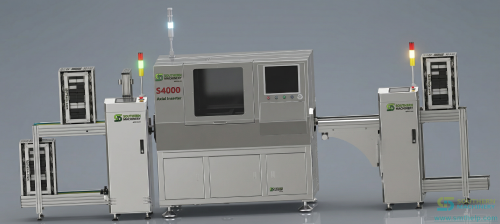
S4000 with automated PCB Loader — inline production configuration
The 5-Minute THT Staffing Audit
Here is a quick exercise you can do today. Fill in your numbers below to estimate your annual cost of manual THT assembly and see when automation starts paying back.
THT Staffing Cost Calculator
Enter your numbers and click Calculate
| Operators per shift: | |
| Monthly cost per operator (RMB): | |
| Number of shifts per day: | |
| Defect rate after Wave Soldering (%): | |
| Annual operator turnover (%): |
If the total annual cost exceeds RMB 500,000 per line, it is worth running a full automation payback analysis. Most Shenzhen EMS factories I have visited are already past this threshold without realizing it.