
How Much Does Manual THT Insertion Really Cost Your Line?
How Much Does Manual THT Insertion Really Cost Your Line?
If you have walked the floor of an EMS factory in the Pearl River Delta over the past decade, you have seen the same pattern. The SMT section runs optimized — Pick and Place machines cycle at tens of thousands of CPH, SPI and AOI catch defects inline, and the Reflow Oven profile is calibrated for each product. But at the THT section, the workflow often looks the same as it did ten years ago: operators seated at a bench, picking components from trays or tubes, inserting them by hand, and passing the boards down the line.
This gap between SMT automation and THT manual labor is not new. What is often missing is a clear calculation of what it costs.
The Direct Labor Number Is Only Part of the Picture
The most visible cost is straightforward: the monthly salary of each THT operator. In Shenzhen, a manual insertion operator typically earns 5,000 to 6,000 RMB per month in base salary. But the total cost per operator is higher when you add social insurance, housing fund, meals, basic PPE, training for new hires, and supervision coverage.
For factories running three shifts, the staffing requirement multiplies. A line that needs 3 operators per shift uses 9 operators total. At an all-in cost of roughly 9,000 RMB per operator per month, that is approximately 81,000 RMB per month in direct labor for a single THT section.
This number alone often triggers a pause. But it is only the first layer of the calculation.
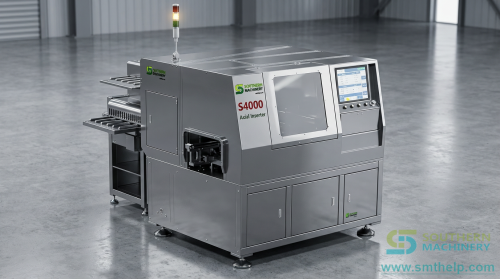
S4000 Axial Insertion Machine — 20,000 CPH, 360-degree rotating table
Defect and Rework Costs Compound
Manual insertion introduces variability that SMT processes are designed to eliminate. Bent leads, wrong orientation, missing components, and inconsistent insertion depth are common when the process depends on hand-eye coordination across multiple shifts and different operators.
Each THT defect typically follows a path: detected at visual inspection or AOI downstream of Wave Soldering, flagged for rework, debugged by a technician (2 to 5 minutes per defect), then repaired and re-inspected. The cost includes not only the technician's time but also the risk of pad lift damage during desoldering, component waste, and the delay to the next board in the queue.
For a factory producing 2,000 boards per day with a 1 percent THT-related defect rate, that is 20 boards per day requiring some level of rework. Over a standard 26-day production month, that is over 500 boards per month — each one consuming rework labor, materials, and inspection time that was not budgeted into the standard cost.
The Throughput Imbalance That Nobody Tracks
The third cost is the hardest to measure and often the largest. When the SMT line outputs a board every 20 seconds but the THT section takes 3 minutes per board with 3 operators working in parallel, the faster process is effectively capped by the slower one.
This imbalance shows up in two forms. In some factories, the SMT line is deliberately slowed or stopped to match the THT pace, directly wasting the capital invested in Pick and Place throughput. In others, WIP accumulates between SMT and Wave Soldering, requiring extra carts, floor space, and material handling labor.
Neither form is captured in standard labor cost reporting, but both reduce the effective throughput of the entire line.
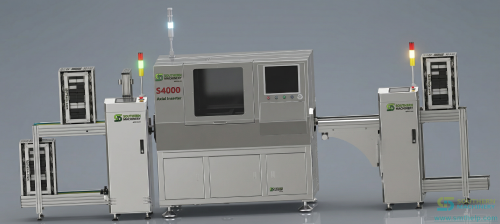
S4000 with auto loader — inline configuration for high-volume PCB assembly
What Changes When THT Is Automated
An axial insertion machine performs the same task — picking a component from tape, forming the leads, inserting into the PCB, and clinching — in under 0.2 seconds per component. At 20,000 CPH, machines such as Southern Machinery's S4000 eliminate the need for manual axial insertion entirely on the boards it serves. The S4000 uses a 360-degree rotating table for orientation, force detection for insertion quality, and clinch control to secure components before Wave Soldering.
For radial components such as capacitors, LEDs, and transistors, the S-3010B Radial Insertion Machine offers an alternative, with an actual throughput of 13,000 CPH across single, dual, or triple span configurations.
The operational logic shifts from headcount to supervision. Instead of 7 to 10 operators per shift manually inserting components, one operator can supervise multiple machines, loading tapes and monitoring production. The defect mechanism also changes: insertion force is consistent across every cycle, orientation is controlled by the Feeder and positioning system, and the clinch holds components at a repeatable angle.
When Auto Insertion Makes Sense — and When It Does Not
The strongest candidates for auto insertion replacement are high-volume production runs — 500 boards or more per batch — where the same component set repeats across multiple lots. LED lighting, power supply, and appliance control boards typically have a high proportion of standard axial resistors, diodes, and radial capacitors that match the Feeder range of these machines.
Lower-volume runs, prototype builds, and boards dominated by odd-form components (large transformers, connectors, relays, hand-soldered through-hole parts) remain better suited to manual or semi-automated approaches. The economic logic depends on the product mix, batch size, and how frequently the line changes over.
Southern Machinery's Insertion Machines support standard SMEMA interface for inline connectivity and EtherCAT bus for MES integration, making them compatible with existing conveyor-based lines. Retrofit kits and feed system upgrades are available for factories that want to phase in automation rather than replace an entire line at once.
A Five-Minute Audit for Your THT Section
The most practical first step is to calculate what your THT section currently costs. The exercise takes five minutes:
- Count the total number of manual THT operators across all shifts
- Multiply by the fully burdened monthly cost per operator (salary plus insurance, meals, training, supervision)
- Estimate the monthly defect rate from your repair log or AOI downstream of Wave Soldering
- Multiply defects by average rework time and technician cost
- Add indirect costs: WIP handling, line stoppages, and supervision hours
Use the calculator below to run the numbers for your factory.
THT Labor Cost Audit Calculator
Fill in your numbers below to estimate the total cost of your manual THT section.
| Operators per shift | |
| Number of shifts | |
| Monthly salary per operator (RMB) | |
| Burden multiplier (1.0 = salary only) | |
| Monthly boards produced | |
| THT defect rate (%) | |
| Rework cost per defect (RMB) | |
| Estimated boards per machine replaced per month |
The first number you get from step 2 is often enough to start the conversation. The full calculation — adding defect costs and throughput losses — typically doubles it.
For a detailed feasibility study or line concept design tailored to your product mix and batch sizes, Southern Machinery provides free consultation and line concept design services.
SMT | THT | PCB Assembly | Auto Insertion | Through Hole | Manual Assembly | Labor Cost