
Fixed-Speed vs Variable-Speed PCB Conveyors: Which Profile Fits Your High-Mix EMS Line?
Fixed-Speed vs Variable-Speed PCB Conveyors: Which Profile Fits Your High-Mix EMS Line?
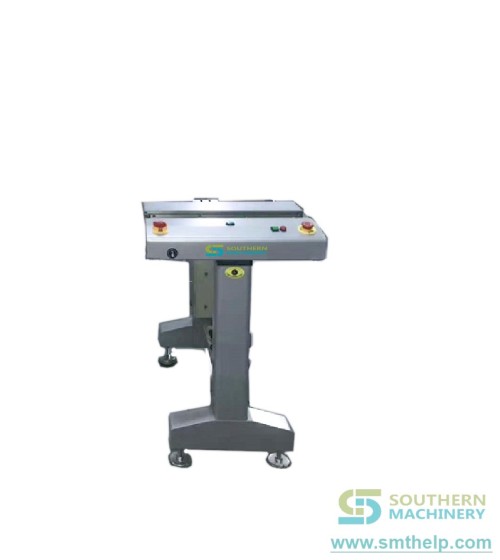
S-H407 High-End Conveyor with motorized width adjustment and SMEMA interface
Your Pick and Place places components at a steady 18-second cycle per board. Your Reflow Oven processes one board every 24 seconds. Your Wave Soldering machine handles each board in 20 seconds. These are the numbers you track, the CPH figures you report, the OEE data you present in weekly production reviews.
But between these machines, there is a gap. Literally.
The conveyor.
If every machine in your SMT/THT line ran at exactly the same speed forever, any conveyor would do. But production lines don't work that way. Reel changes, Nozzle cleaning, temperature recovery in the Reflow Oven, maintenance pauses on the Wave Soldering — each event creates a few seconds of asymmetry. Multiply that across three shifts, five days a week, and the question is no longer about machine CPH alone.
The question is: does your board handling absorb those asymmetries, or amplify them?
The Hidden Gap Between Machine CPH and Line Throughput
Most Process Engineers can tell you the cycle time of every machine in their line within 5 percent. Far fewer can tell you the SMEMA (Standardized Machine to Machine Interface) handshake timing between those same machines.
This is not a small gap. In production lines where conveyors run at a fixed speed regardless of upstream or downstream status, the most common failure pattern looks like this:
Board A exits the Pick and Place. The conveyor accepts it at a fixed 12 m/min belt speed and transports it toward the Reflow Oven. But the Reflow Oven is still processing Board B — its entry buffer zone is occupied. Board A arrives at the Reflow entry sensor, triggers a SMEMA "board present" signal, and the Reflow oven responds with "busy." Board A stops. Board B exits the Pick and Place. Now Board B is on the same conveyor section.
If the timing is tight, both boards end up on the same conveyor segment, neither can advance, and the Pick and Place's exit sensor stops sending new boards. The entire upstream line stalls.
This scenario accounts for a measurable fraction of unplanned line stoppages in EMS factories running mixed-product lines. The cause is not machine failure. The cause is conveyor profile mismatch: the board handling system treats all products and all speed profiles the same.
Fixed-Speed vs Variable-Speed: When Each Works
Fixed-speed conveyors run at a constant belt speed regardless of whether the downstream machine is ready. They are simple, inexpensive, and reliable for lines processing a single product at a stable throughput. A standard edge-belt conveyor such as Southern Machinery's PCB-1000 or PCB-2000 series — with ESD-safe belts, SMEMA 4-pin interface, and speeds of 0.5-20 m/min — is perfectly adequate when every machine in the line runs at a matched cycle time and product changeovers are infrequent.
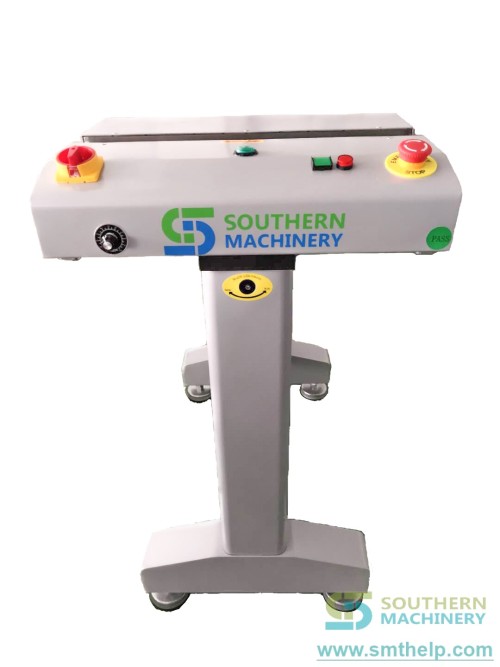
S-H407 stainless steel frame and antistatic edge-belt design
Variable-speed conveyors, by contrast, adjust belt speed based on sensor input from upstream and downstream machines. When the downstream machine signals "busy," the variable-speed conveyor slows or stops. When it signals "ready," speed resumes. This sensor-driven speed control allows boards to accumulate in a controlled buffer zone rather than stacking at a fixed-speed transfer point.
This difference matters most in two specific manufacturing profiles:
First, high-mix EMS lines where product changeovers shift the CPH balance between machines. A board that runs through the Pick and Place in 14 seconds may need 22 seconds in the Reflow Oven. Without a variable-speed buffer conveyor, the faster machine is forced to wait — and that wait time is not captured by individual machine CPH metrics.
Second, lines where brief machine pauses are frequent. Reel splicing, Nozzle cleaning cycles, temperature recovery, and operator intervention all create 30-second to 2-minute windows where one machine stalls while others continue. A fixed-speed conveyor cannot absorb these windows. A buffer conveyor with accumulation capacity, such as the S-350C (which stores up to 20 PCBs with adjustable 0.5-20 m/min speed and full SMEMA handshake), can absorb these micro-stops without disrupting upstream flow.
What Changes When You Add a Variable-Speed Buffer
The measurable effect is not dramatic at the individual board level. A variable-speed conveyor does not place components faster. It does not improve solder joint quality. What it changes is the recovery time from micro-stops.
Consider a line running 500 boards per shift on a single product with a Pick and Place cycle of 18 seconds, Reflow cycle of 22 seconds, and an average of three unscheduled micro-stops per hour lasting 45 seconds each.
With fixed-speed conveyors and no buffer zone, each micro-stop propagates upstream. The 45-second pause at the Reflow Oven becomes a 45-second pause at the Pick and Place exit. Over ten hours, that is 22.5 minutes of upstream idle time — approximately 75 lost board placements at 18 seconds each.
With a variable-speed buffer conveyor such as the S-350C placed between the Pick and Place and the Reflow Oven, the picture changes. During the 45-second Reflow pause, the buffer absorbs up to 2-3 boards accumulating from the Pick and Place. When the Reflow oven signals ready, the buffer releases boards at its adjustable speed. The Pick and Place never stops.
The 75 lost placements become zero.
This pattern repeats across every micro-stop in the line. Over a week, a month, a quarter, the compounding effect on real CPH (boards actually completed, not machine cycle rate) is meaningful.
When Variable-Speed Is Overkill
Not every line needs variable-speed board handling. Three conditions where fixed-speed conveyors remain the appropriate choice:
Single-product lines with balanced machine CPH. If your Pick and Place, Reflow Oven, and Wave Soldering all process boards at nearly identical cycle times, and the product stays the same for weeks at a time, the additional cost of sensor-controlled variable-speed conveyors may not justify itself.
Low-utilization lines running one shift or low volumes. When total daily output is low enough that micro-stops can be absorbed by shift-end overtime or the line has built-in slack, the buffer zone adds complexity without measurable gain.
Lines with integrated machine-to-machine direct transfer. Some modern Pick and Place and Reflow Oven pairs have built-in SMEMA synchronization that effectively acts as a variable-speed handshake. In these cases, an external variable-speed conveyor adds redundancy rather than capability.
For the majority of EMS factories running medium-to-high mix, two-shift or three-shift operations, the variable-speed or buffer conveyor profile is not a luxury. It is an OEE correction mechanism that targets one of the most common invisible throughput drains: inter-machine waiting time.
Retrofitting Without Rebuilding
A common concern is that upgrading board handling requires reconfiguring the entire line. This is not the case. SMEMA-standard conveyors use a 4-pin interface that is uniform across virtually all SMT and THT equipment. Replacing a fixed-speed 1000mm conveyor section with a variable-speed buffer unit such as the S-350C or upgrading to an antistatic motorized-width conveyor such as the S-H407 is a remove-and-replace operation that takes less than one shift.
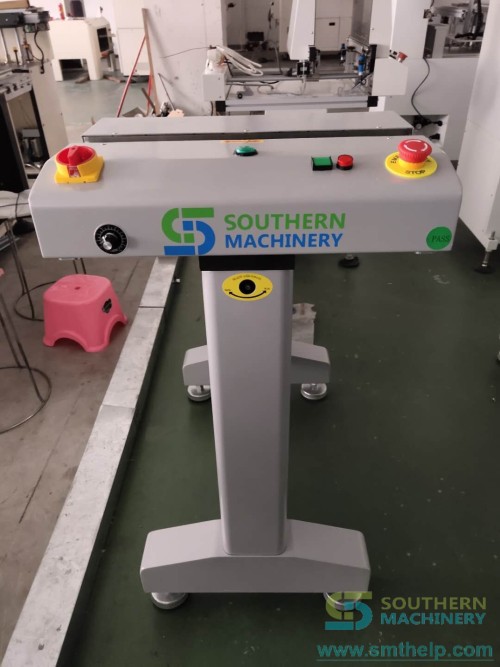
S-H407 Conveyor — SMEMA-compatible, motorized width adjustment
The economic logic is favorable. A single conveyor section costs a fraction of the main production equipment it connects. If that section recovers even 2-3 percent of line OEE by absorbing micro-stops, the upgrade pays for itself in months rather than years.
Conveyor Profile Audit Tool
The five checks below will tell you whether your board handling profile is costing throughput. Use the scoring tool to calculate your result.
PCB Conveyor Profile Audit
Score each check. Add up your total and see the recommendation below.
| # | Check | Score |
|---|---|---|
| 1 | Board spacing during steady production: inconsistent gaps with bunching? (Yes=1, No=0) | |
| 2 | During a micro-stop, does the upstream machine stop within 30 seconds? (Yes=1, No=0) | |
| 3 | SMEMA "busy" signal flashes more than once every 5 boards? (Yes=1, No=0) | |
| 4 | Conveyor width changeover takes over 2 minutes? (Yes=1, No=0) | |
| 5 | Line runs 2+ products or 2+ shifts? (Yes=1, No=0) |
Need Help Selecting the Right Conveyor Profile? Southern Machinery offers both fixed-speed (PCB-1000/2000 series) and variable-speed (S-350C buffer, S-H407 motorized) conveyor solutions. Contact our team for a free line audit concept. Email Jason Wu or Visit smthelp.com