
One Operator, Four Machines: Is the 1:4 Staffing Model Realistic for THT Assembly?
One Operator, Four Machines: Is the 1:4 Staffing Model Realistic for THT Assembly?
Walk into most THT assembly lines and you will see the same layout: one operator standing at each insertion machine, waiting for the cycle to finish. The machine runs, the operator watches, the cycle ends, the board moves on. Then it repeats.
This 1:1 staffing pattern is so common that few factory managers question it. But the economics of modern auto insertion have shifted. An axial insertion machine running at 20,000 components per hour completes a typical board in 15 to 30 seconds. The machine loads, inserts, clinches, and indexes automatically. The operator's job, in between cycles, is replenishment — refilling Feeders, clearing the occasional jam, and checking clinch quality.
If the machine handles the entire insertion sequence without human intervention, why does it need a dedicated operator per station?
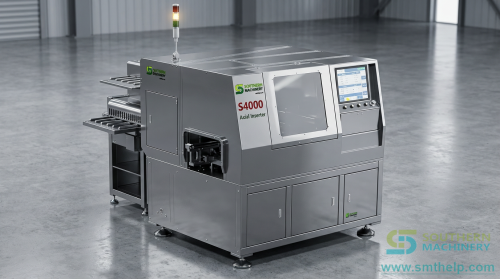
S4000 Axial Insertion Machine — 20,000 CPH, 100+ station capacity, autonomous operation
The Hidden Cost of 1:1 Staffing
The cost of 1:1 staffing adds up fast. On a four-machine line running three shifts, you are paying for 12 operators. If the average monthly cost (salary, benefits, housing) in the Pearl River Delta is roughly RMB 6,000 to 8,000 per production worker, that line costs RMB 72,000 to 96,000 per month in labor — just for machine attendance.
The question is: how much of that time is actually productive?
From observations across EMS factories in Shenzhen, the typical operator at an insertion machine spends between 5 and 12 minutes per hour on actual hands-on tasks: replenishing components, clearing a misfeed, inspecting the clinch, or handling a finished PCB. The remaining 48 to 55 minutes are standby — watching the machine run.
That is roughly 80 to 90 percent idle time per operator.
Over a year, a 1:1-staffed line is carrying RMB 70,000 to 90,000 per operator per year in effectively idle labor cost. Multiply by 12 operators, and the annual overhead from unnecessary attendance alone can reach well into six figures.
Labor scarcity compounds the problem. EMS factories across the PRD report difficulty filling THT operator positions. Attrition rates for manual insertion workers are higher than for SMT operators, because the work is repetitive and the skill ceiling is low. The factories that solve this by reducing headcount instead of increasing recruiting spend have a structural advantage.
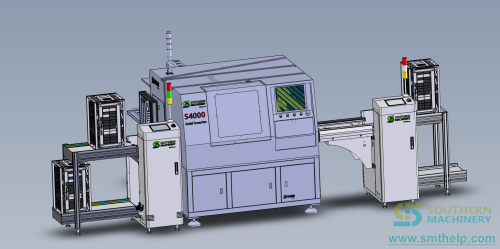
S4000 with 10-station Feeder array and auto loader — designed for prolonged autonomous runs
How the 1:4 Model Works in Practice
The key insight is that modern auto insertion machines are designed for autonomous operation. They do not need continuous attention — they need periodic service.
Take an axial insertion machine such as Southern Machinery's S4000. At 20,000 CPH with a 360-degree rotating table, 100-plus station component capacity, and programmable clinch, it can run through dozens of boards before the operator needs to intervene. The machine handles polarity verification through vision alignment and communicates its status via EtherCAT to an MES or line control system.
A radial insertion machine such as the S-3010B, available in single-span through quad-span configurations, handles radial components (capacitors, LEDs, transistors) with similarly long autonomous runs. The radial tape Feeder system allows 50 to 80 component types to be loaded at once, reducing Feeder change frequency.
For DIP components, the S3000 PCB Dip Assembly Radial Insertion Machine manages up to 10 stations with a 0.7 mm maximum lead diameter, handling standard DIP packages with minimal operator intervention.
The 1:4 model works when the line is set up for batch runs of sufficient length. The operator's role shifts from machine attendant to line coordinator: loading component reels and tapes for the next lot, moving finished PCBs to Wave Soldering, performing quick quality checks between cycles. Instead of standing at one machine, the operator patrols four in a rotation.
In practice, the cycle looks like this:
- Machine A starts a new board. Run time: 22 seconds.
- Operator walks to Machine B, checks the last board's clinch quality. Time: 30 seconds.
- Machine B finishes, starts next board. Run time: 18 seconds.
- Operator walks to Machine C, replenishes a tape Feeder. Time: 45 seconds.
- Machine C finishes. Operator loads a new PCB panel. Time: 10 seconds.
- Operator returns to Machine A for the next check cycle.
The entire loop takes roughly 90 to 120 seconds. Each machine gets attention every 90 to 120 seconds. No machine sits idle waiting for an operator.
The conditions for this to work are straightforward but non-negotiable:
- Batch size large enough that setup time is a small fraction of total run time
- Component variety within the machine's station capacity — 100-plus for axial, 50-plus per machine for radial
- Feeder replenishment planned by lot, not by ad-hoc shortage
- Wave Solder or Selective Solder process timed to match the line's output rate
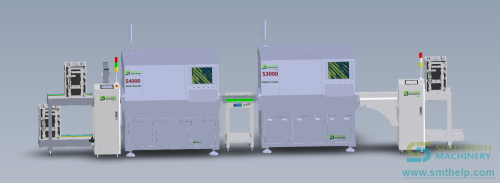
Combined S4000 axial and S3000 radial insertion line — one operator can manage a multi-machine layout
When the 1:4 Model Does Not Fit
Not every line can run 1:4. The model breaks down in three common scenarios:
High-mix, low-volume lines. If the factory runs 10+ board types per shift and changeovers happen every 30 to 60 minutes, the operator spends more time changing programs, swapping Feeders, and verifying first articles than running production. In this case, 1:2 or 1:3 may be the practical ceiling.
Lines with a high proportion of odd-form components. Transformers, connectors, relays, and large electrolytic capacitors often require manual placement even on an auto insertion line. The more manual steps in the process, the harder it is for one operator to manage four insertion machines and the odd-form station simultaneously.
New product introduction (NPI) runs. When a new PCB is being qualified, the operator and process engineer typically need to verify insertion quality, adjust clinch parameters, and watch the first 20 to 50 boards closely. During NPI, a 1:1 ratio is standard practice.
The good news for existing lines is that moving toward 1:4 does not require replacing equipment. It requires rethinking staffing allocation, Feeder layout optimization, and scheduling discipline. The machines already have the capability — the question is whether the production system can support the reduced attention ratio.
The 10-Minute Staffing Audit
Here is a practical way to assess whether your line is ready for a reduced staffing ratio.
Step 1: Track one shift. For each insertion machine on the line, record:
- How many operator interactions occur per hour (replenish, jam clear, QA check, board load/unload)
- The average duration of each interaction
Step 2: Calculate total hands-on time. If a machine requires 8 interactions per hour at 45 seconds each, the total hands-on time is 6 minutes per hour. The remaining 54 minutes are autonomous.
Step 3: Compare across machines. If all four machines on the line require 4 to 8 minutes of hands-on time per hour, one operator can cover all four with a service interval of under 2 minutes per machine.
Step 4: Identify the constraint. If one machine consistently requires 15+ minutes of attention per hour, examine why. Is it a component shortage pattern? A recurring jam at a specific station? A Feeder that needs maintenance?
Step 5: Set a target. If the line's total hands-on requirement across four machines is under 30 minutes per hour, the 1:4 model is realistic. Between 30 and 45 minutes, the line can run 1:3. Above 45 minutes, address the constraint before reducing headcount.
Interactive Staffing Calculator
Evaluate Your Line's Staffing Ratio
Enter your numbers per machine per hour and click Calculate.
Southern Machinery designs and builds auto insertion machines for axial, radial, and DIP components. The S4000, S-3010B, and S3000 are examples of modern inserters built for high-autonomy THT assembly. For factories exploring staffing optimization, a line audit is the first step — and the ROI on reducing one operator per shift per machine is substantial.