
When Manual THT Insertion Becomes the Hidden Cost Center
Every factory running mixed SMT and THT lines knows the visible cost of manual insertion: the wages of the operators at the workbench. In the Pearl River Delta, where EMS providers serving LED lighting, power supply, and automotive manufacturing operate three-shift THT lines with 8 to 12 operators per shift, this annual labor line item is clear on the P&L.
What is less clear is what each insertion actually costs once you include training churn, inspection, rework, and throughput variability. If your factory runs 24 operators across three shifts at 400 to 600 CPH each, you are producing 9,600 to 14,400 insertions per hour — each one subject to operator skill, fatigue, and attention.
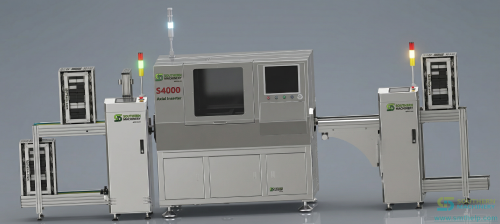
S4000 Axial Insertion Machine with automatic PCB loader
The Hidden Cost Stack
Layer one is direct labor. For a PRD factory running 24 operators on THT, several hundred thousand RMB annually. Visible on the P&L.
Layer two is training and turnover. Operator turnover of 30 to 50 percent annually is common. Each new hire needs two to four weeks to reach standard CPH. During ramp-up, effective CPH drops 30 to 40 percent and defect rates rise.
Layer three is rework. Manual THT insertion sees rework rates of 2 to 5 percent. Each misaligned lead or floating high component passes downstream to Wave Soldering, creating cold joints and bridges that require inspection time and rework labor.
When these layers combine, the effective cost per manually inserted component can be three to five times the direct wages line item alone.
How Auto Insertion Changes the Equation
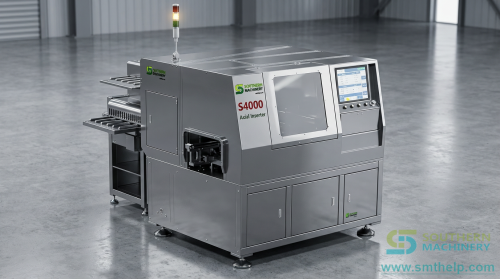
S4000 Axial Insertion Machine — 20,000 CPH
For axial components (resistors, diodes, jumpers): machines such as Southern Machinery's S4000 operate at 20,000 CPH — replacing 30 to 40 manual operators. It uses a 360-degree rotating table, 100+ stations, EtherCAT bus control, and MES-ready interface. Vision alignment catches bent leads, reverse polarity, and missed holes before the board advances.
For radial components (capacitors, LEDs, transistors): the S-3010B delivers 13,000 CPH actual speed with four-span insertion (2.5 to 10.0 mm) and machine vision calibration.
For odd-form components (transformers, connectors, relays): the S-70LD uses vision-guided programmable insertion for non-standard packages.
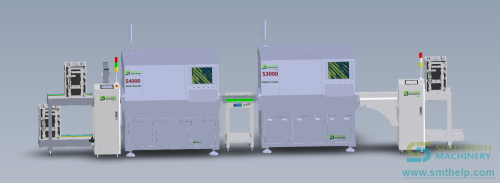
Combined S4000 Axial and S3000 Radial Insertion line with feeder system
A common pattern in PRD EMS factories: one operator managing four auto insertion machines. The role shifts from repetitive insertion to machine tending — loading reels, monitoring vision output, addressing Feeder jams.
When and Where This Applies
Strongest return for: high-volume stable products, PCB sizes 50x50 to 400x400 mm, standard lead pitch. LED lighting, power supplies, appliance control boards, automotive electronics.
For low-volume high-mix production, manual insertion may remain practical. ROI ranges from 12 to 24 months depending on labor cost, product mix, and line configuration.
Calculate Your THT Staffing Cost
THT Staffing Cost Calculator
| Parameter | Value |
|---|---|
| Operators per shift | |
| Shifts per day | |
| Avg CPH per operator | |
| Rework rate (%) | |
| Annual cost per operator (RMB) | |
| Working days per year |
The exercise above gives you a ballpark figure. For a detailed analysis of your specific line configuration, contact Jason Wu at jasonwu@smthelp.com or +86 13602562576 for free proofing and line concept design support.
- How many operators work on THT insertion across all shifts?
- What is the average CPH per operator, including new hires in ramp-up?
- What is your current rework rate on THT-inserted boards?
- What is the annual cost of training and turnover for your THT team?