
The Hidden Cost of Manual THT Insertion and When Auto Insertion Changes the Math
The Hidden Cost of Manual THT Insertion — and When Auto Insertion Changes the Math
The Gap Between Direct Labor Cost and Total THT Cost
Walk into most EMS assembly plants and ask how much it costs to populate a through-hole PCB. The answer comes back fast: the operator's hourly wage, divided by the number of components they insert per hour. Simple math. Clean spreadsheet. Wrong answer.
In over a decade of working alongside plant managers and process engineers across Asia and Europe, I have yet to meet a single factory that actually captures the full cost of manual THT insertion on their ERP or MES dashboards. What shows up on the P&L is the direct labor line. What does not show up — but quietly bleeds margin shift after shift — is everything else that happens when humans sit at a workstation with a bin of axial resistors, a forming tool, and a PCB passing by on a pallet.
The gap between "labor cost" and "total cost" for manual THT insertion is not small. From field observation, the multiplier between direct wage cost and the fully loaded cost of a manual THT station — accounting for defects, rework, training, supervision, and line imbalance — often lands in a range that would make any operations director pause. Yet the industry standard is to plan around the lower number, approve headcount based on the lower number, and then absorb the delta silently in the rework department and the overtime budget.
This article breaks down those hidden costs one by one, then walks through the threshold where auto insertion starts to change the math for real.
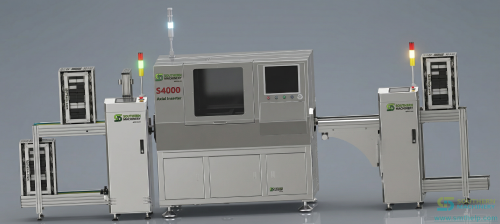
S4000 Axial Insertion Machine with automatic PCB loader — designed for high-volume axial component assembly
The Hidden Cost Breakdown
Rework: The Cost That Gets Capitalized Elsewhere
When a manual operator inserts a diode backwards, or misses a resistor entirely, or leaves a lead unclinched, the cost of that error does not stay on the THT line's ledger. It moves downstream. The PCB travels through Wave Soldering, emerges with a cold joint or a tombstoned component, gets flagged at AOI or visual inspection, and then enters the rework loop.
Rework on a THT board is rarely as simple as "touch up one joint." The board must be pulled from the line, inspected, brought to a rework station, the part desoldered (often damaging the plated through-hole in the process), a new component prepared and inserted, and the board re-soldered and re-inspected. For boards with high component density — power supplies, LED drivers, industrial control PCBs — the access constraints alone add time. A misinserted axial diode in a dense array may require removing two neighboring components just to reach it.
The fully loaded cost of that rework cycle includes: the operator's time for desoldering and re-insertion, the soldering iron tip wear, the consumables (desoldering braid, flux, replacement components), the AOI or visual inspection retest, and — most expensive of all — the production downtime or line stoppage if the defect is caught during in-circuit test rather than at visual inspection.
From experience, factories that track rework by root cause consistently find that manual THT insertion contributes a disproportionate share of total PCBA rework events relative to its labor content. This is not because manual operators are unskilled. It is because THT insertion is a high-finger-motion, high-focus task sustained over long production runs, and human error rates follow a fatigue curve that shifts by the hour.
Training Churn and the Experience Curve
The second hidden cost is the fade in and out of operator proficiency. Manual THT insertion is not a commodity skill. An experienced operator develops muscle memory for lead forming, polarity identification, component orientation, and insertion force. They learn the subtle differences between a tight-fit through-hole and one that is slightly off-spec. They build speed — measured in components per hour (CPH) — that can be two to three times that of a new hire.
But in many EMS facilities, operator turnover on the THT line runs noticeably higher than on the SMT line. The SMT line is perceived as higher-status work, operating expensive Pick and Place machines. The THT line is seen as manual labor. The result is a constant churn: train an operator for two to three weeks, get three to six months of productive work, and then replace them.
Each replacement carries a direct training cost — the trainer's time, the reduced line speed during the learning curve, the higher defect rate while the new operator builds proficiency — and an indirect cost: the variability in throughput and quality that the production planner cannot predict. A line that runs at a predictable 800 insertions per hour one month may drop to 500 the next month simply because the experienced operator left and a new one is learning.
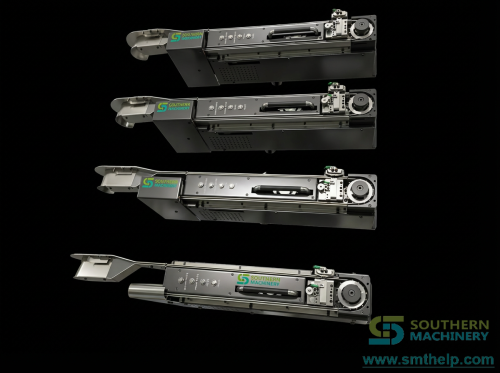
Radial taped feeder — automated component feeding for radial insertion machines
Yield Variability Across Shifts
Even within the same week, the same product, the same BOM, manual THT yield varies. The day shift, where operators are fresh and supervision is present, typically runs tighter. The night shift or weekend shift, where supervision is thinner and fatigue is higher, sees more variation.
This is not a people problem; it is a process-control problem. Manual insertion has no closed-loop feedback. There is no AOI at the insertion station, no SPI-equivalent for through-hole lead placement, no machine-reported CPH trend that alerts management when a station is drifting. The first signal of a yield issue often comes hours later, at Wave Soldering or the in-circuit test, by which point an entire batch may need quarantine.
Over a production year, yield variability across shifts creates a "worst-case" rework cost that is significantly higher than the average cost that appears in the annual budget. Smart process engineers know this. Few plant managers have the reporting to quantify it.
Line Balancing Losses
In a mixed-technology PCBA line — SMT top side, THT bottom side, Wave Soldering, selective soldering, manual insertion islands — the THT manual stations are almost always the bottleneck. Not because the work content is high, but because the work content is variable.
An SMT line running a well-optimized Pick and Place program is predictable to within a few seconds per board. A manual THT station's cycle time varies by operator, by batch, by component mix, by time of day. Production planners compensate by padding the cycle time estimate, which means the entire line is effectively governed by the slowest manual station's worst-case performance.
The resulting idle time on the SMT line — expensive capital equipment waiting for boards to come back from the THT island — is a cost that rarely gets attributed to the manual insertion process. But it is a direct consequence of choosing manual over automated THT insertion.
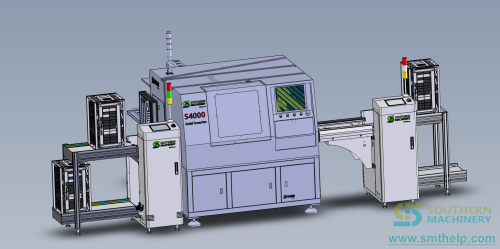
S4000 with 10 Feeders and automatic PCB loader — a complete axial insertion work cell
When Automation Changes the Math
So where is the threshold?
There is no single CPH number or board volume that universally flips the economics. The threshold depends on the component mix, the batch size, the rework rate, and the labor market in the factory's region. But the variables that shift the math toward automation are identifiable:
Component count per board. A board with under five THT components may never justify tooling changeover time on an auto inserter. A board with twenty or more axial or radial components — common in power supplies, LED lighting, and industrial controls — begins to accumulate enough insertion cycles that the CPH advantage of a machine becomes material.
Batch stability. High-mix, low-volume environments (fifty boards of one SKU, then a different SKU) see the threshold shift higher because changeover time must be amortized over fewer boards. Stable medium-to-high volume runs are where auto insertion closes the cost gap fastest.
Rework rate sensitivity. This is the variable most factories underestimate. If the hidden rework cost of manual insertion is, say, two to three times what the ERP shows, the breakeven volume for automation drops significantly. A machine does not insert components backwards at 2:00 AM. Its CPH is repeatable within specification across all shifts.
Labor availability and stability. In regions where experienced THT operators are scarce or expensive, or where turnover is high, the training-churn cost alone can justify the transition. One operator can manage multiple auto insertion machines — for example, tending the Feeder loading and PCB loading on an axial inserter while a radial machine runs autonomously. The labor leverage is not 1:1; it is closer to 1:3 or 1:4.
To make this assessment concrete, consider a common production scenario: a PCBA with 35 axial resistors, 8 diodes, and 6 radial capacitors — typical of an LED power supply or an industrial relay board. At manual rates, an experienced operator might achieve 600 to 800 CPH over a full shift. An axial auto insertion machine such as Southern Machinery's S4000, rated at 20,000 CPH, completes the same axial population in a fraction of the time. The machine handles axial components — resistors, diodes — and is commonly used in LED and power supply manufacturing. A radial machine such as the S-3010B covers the capacitors, transistors, and LEDs. For non-standard parts — transformers, connectors, relays — the S-70LD Odd Form Insertion Machine addresses components that do not fit axial or radial tape formats.
The operator does not need to sit at each machine. One operator can load Feeders, unload populated PCBs, and manage changeovers across several machines running in parallel. The CPH leverage shifts from a single operator's output to the combined throughput of the machine group.
The key insight is not that automation is cheaper in all cases. It is that the breakeven calculation changes dramatically once you include the costs that most factories leave out of the spreadsheet.
Realistic Retrofit Paths
For an existing manual THT line, the transition to automation does not have to happen all at once. There are incremental steps that reduce risk and build confidence in the machine's performance on the factory's actual product mix.
Step 1: Audit the component mix. Separate the BOM into three categories: axial (resistors, diodes), radial (capacitors, transistors, LEDs), and odd-form (transformers, connectors, relays, large electrolytics). For many power supply and industrial control boards, the axial and radial categories account for 60 to 80 percent of the total THT component count. The odd-form components remain manual or semi-manual.
Step 2: Automate the high-volume category first. Introduce an axial auto inserter for the resistors and diodes. This single step captures the largest share of insertion cycles. The S4000, for example, is designed for exactly this application and runs at 20,000 CPH. Keep the radial and odd-form stations manual during the pilot phase.
Step 3: Validate the rework reduction. Measure the defect rate on the automated axial population versus the remaining manual population. The difference — fewer polarity reversals, fewer missing components, fewer bent leads — translates directly into lower downstream rework cost. This is the data point that justifies the next investment.
Step 4: Expand to radial insertion. Once the axial line is stable, add a radial inserter for the capacitors and transistors. The S-3010B supports radial component formats and integrates into the same workflow. At this point, only the odd-form components remain manual.
Step 5: Address odd-form selectively. Odd-form components require more flexible handling — vision-guided placement, custom grippers, or tooling changeovers. The S-70LD addresses this category. Many factories choose to automate odd-form only for their top-volume SKUs.
This phased approach avoids the all-or-nothing risk that sometimes derails automation projects. Each step generates its own ROI data, which feeds the business case for the next step.

CE MD certification for Southern Machinery's axial insertion machine — ensuring compliance with European safety standards
The 5-Minute THT Staffing Cost Exercise
Here is a practical exercise you can run this afternoon. It takes roughly five minutes and will tell you whether your current THT costing is leaving money on the table.
Step 1. Pull the current headcount on your manual THT insertion lines. Count operators, not stations — one station with two shifts counts as two operators.
Step 2. Estimate the fully loaded annual cost per operator. Do not use the direct wage. Include: salary, benefits, overtime premium, recruitment fees, training hours, and the supervisor's time allocated to the THT line.
Step 3. Add the rework cost for THT-related defects. If your MES or AOI tracks defects by root cause, filter for "THT insertion" as the cause category. If you do not have this data, take the total PCBA rework cost for your facility and estimate the THT share.
Step 4. Divide the total (labor + rework) by the number of THT components inserted per year. This is your actual cost-per-insertion.
Step 5. Compare that cost-per-insertion to the amortized cost-per-insertion of an auto insertion machine at your volume, using the manufacturer's published CPH and your labor rate for the operator who would tend the machine.
If the manual cost-per-insertion is close to or above the automated cost-per-insertion, the threshold has shifted. The math now favors a conversation about automation — not because the machine is inherently cheaper, but because the full cost of manual insertion has finally been accounted for.
THT Staffing Cost Calculator
Fill in your numbers and click Calculate to see your fully loaded manual insertion cost
About Southern Machinery: Based in Shenzhen, China, Southern Machinery (also known as SMThelp) specializes in SMT and THT auto insertion equipment. Products include the S4000 Axial Auto Insertion Machine (20,000 CPH), S-3010B Radial Insertion Machine, and S-70LD Odd Form Insertion Machine. The company provides factory automation solutions for EMS, power supply, LED lighting, and industrial control manufacturers worldwide. For more information, visit www.smthelp.com.