
Auto Insertion ROI: A Three-Step Calculation for THT Lines
Auto Insertion ROI: A Three-Step Calculation for THT Lines
If you have read our previous article on when to consider auto insertion, you probably have one follow-up question: “How much can I actually save?”
The honest answer is: it depends. But it depends on a few specific variables that you can measure and calculate yourself. This article walks through a three-step framework to estimate the ROI of a THT auto insertion investment — using your own production data.
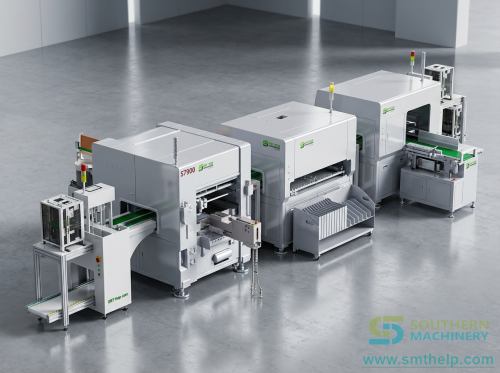
Why Most ROI Estimates Are Wrong
The most common mistake in auto insertion ROI calculation is simple: it only counts direct labor replacement. The logic goes: “I have 10 manual operators at $X per hour, a machine costs $Y, so payback is Z months.”
This misses three important factors:
- Utilization rate — a machine does not run at 100% from day one
- Defect rate impact — auto insertion typically reduces misinsertion, missing components, and polarity errors
- Rework and inspection savings — fewer defects means less time spent on touch-up and AOI review
A realistic ROI calculation includes all three.
Step 1: Calculate Your Current Per-Board THT Labor Cost
Start with one number: the fully loaded labor cost per board for manual THT insertion.
Formula:
(Labor cost per hour × Average insertion time per board) ÷ Number of operators × Efficiency factor
A realistic example:
- Labor cost per hour: $5.00 (fully loaded)
- Operators on one line: 8
- Insertion time per board: 3 minutes (0.05 hours)
- Efficiency factor: 0.85 (15% downtime, breaks, fatigue)
Per-board labor cost = ($5.00 × 0.05) × 8 ÷ 0.85 = $2.35 per board
If you produce 100,000 boards per month, that is $235,000 per month or $2,820,000 per year in manual THT labor.
Key insight: If your per-board labor cost for THT is above $1.50, there is likely a measurable ROI case for automation.
Step 2: Estimate Auto Insertion Throughput and Utilization
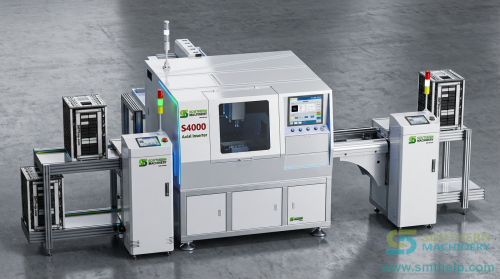
Not all auto insertion machines run at the same speed. A radial or axial machine such as Southern Machinery’s S3010A or S4000 can achieve 6,500 to 13,000+ CPH depending on component type, board layout, and Feeder configuration. An odd-form machine handles a different range but covers components that radial or axial machines cannot.
Formula:
Machine cost per board = (Machine price ÷ Estimated useful life in months) ÷ (Monthly production volume × Utilization rate)
Using the same 100,000 boards/month example:
- Machine price: $45,000 (example for a radial insertion machine)
- Useful life: 60 months (5 years)
- Utilization rate: 75% (first year, realistic)
- Board THT components: 12 per board
- Machine speed: 8,000 CPH (average for mixed radial/axial)
Machine labor: 1 operator can manage up to 4 machines
Machine cost per board: $45,000 ÷ 60 = $750/month → $750 ÷ (100,000 × 0.75) = $0.01 per board (equipment cost only)
Operator cost per board (1 operator managing 4 machines): $5.00 per hour × 0.05 hours per board ÷ 4 = $0.0625 per board
Total auto insertion cost per board: $0.0725
Comparison: Manual was $2.35 per board → Auto insertion is $0.07 per board
Monthly savings: ($2.35 - $0.07) × 100,000 = $228,000 per month
This looks dramatic — and in high-volume, stable mix scenarios, it can be. But this is before factoring in real-world constraints.
Step 3: Factor in the Hidden Savings
The direct labor comparison above is compelling, but the real picture includes additional savings that are often overlooked:
Defect reduction. Manual insertion defect rates vary by factory, with some reporting 50 to 200 PPM for misinsertion, missing components, and polarity errors, depending on operator experience and shift length. Auto insertion with vision alignment and force detection typically achieves under 20 PPM for the same defect types.
For 100,000 boards with 12 THT components each:
- Manual: 60 to 240 defects per month
- Auto: under 24 defects per month
At an average rework cost of $2.00 per defect (labor, solder touch-up, re-inspection), this saves $72 to $432 per month.
Inspection savings. Fewer defects means less time on AOI review and Wave Soldering touch-up. Some factories report a 30 to 50 percent reduction in post-Wave Soldering inspection time after switching to auto insertion.
Consistency across shifts. Manual insertion quality varies between operators and across shift changes. Auto insertion produces consistent results regardless of shift timing.
A Worked Example
| Metric | Manual | Auto Insertion |
|---|---|---|
| Operators per line | 8 | 1 (manages 4 machines) |
| Per-board labor cost | $2.35 | $0.07 |
| Defect PPM (insertion) | Varies (50-200) | <20 |
| Monthly rework cost | Varies | Typically 80% lower |
| Consistency | Varies by operator | Repeatable |
For a line producing 100,000 boards per month:
- Monthly manual cost: $235,000
- Monthly auto cost: $7,250
- Machine investment: ~$45,000
- Payback period: approximately 2 months in the high-volume example shown
With first-year utilization at 75%, the adjusted payback would be approximately 4 to 6 months — still well within the typical 12 to 24 month range for most production environments.
Common Mistakes in ROI Calculation
- Forgetting changeover time. Factor 30 to 60 minutes per changeover into utilization assumptions
- Using theoretical CPH instead of real CPH. Real throughput depends on board layout, component mix, and Feeder setup. Use 70 to 80 percent of rated speed for first-year estimates
- Ignoring training costs. Operators and maintenance staff need 2 to 4 weeks to reach full efficiency
- Overestimating utilization. 70 to 80 percent utilization is realistic for the first year; 85 to 90 percent is achievable after the first year
A Practical Starting Point
If you want to run this calculation for your own line, the simplest way is to start with your current per-board THT labor cost and compare it to the estimated auto insertion cost using the formulas above.
Southern Machinery provides a free line concept design and consultation service, including a custom ROI analysis based on your actual production data, board files, and component mix. Products such as the S3010A (vertical radial) and S4000 (horizontal axial) are examples of auto insertion machines in this category.
ROI Calculator Template
Use this simplified table to estimate your own payback range:
| Variable | Your Data |
|---|---|
| Monthly THT board volume | __ boards |
| Manual operators on one line | __ operators |
| Labor cost per hour (fully loaded) | $__ |
| Average insertion time per board | __ minutes |
| Current per-board labor cost (calc) | $__ |
| Machine investment estimate | $__ |
| Estimated CPH (for your components) | __ CPH |
| Estimated first-year utilization | __ % |
| Estimated machine cost per board | $__ |
| Estimated monthly savings | $__ |
| Estimated payback period | __ months |
About the author: This article was prepared by the technical team at Southern Machinery, a Shenzhen-based SMT/THT equipment manufacturer with 20+ years of industry experience. We specialize in auto insertion machines, Pick and Place, Wave Soldering, and custom SMT solutions. Contact us at jasonwu@smthelp.com for a free line concept design and ROI analysis.
Download ROI Calculator Template
A one-page PDF to help you run the three-step calculation with your own production data.
Download ROI Calculator Template (PDF)
Download 5-Condition Readiness Checklist