
PCB Board Handling: The Hidden Bottleneck Between SMT and THT
PCB Board Handling: The Hidden Bottleneck Between SMT and THT
One operator can run four SMT machines — but only if the PCBs arrive at the right place, at the right orientation, at the right time. That precondition depends entirely on how boards move between process steps. And in many mid-volume EMS factories, that movement is one of the most under-measured variables in the line.
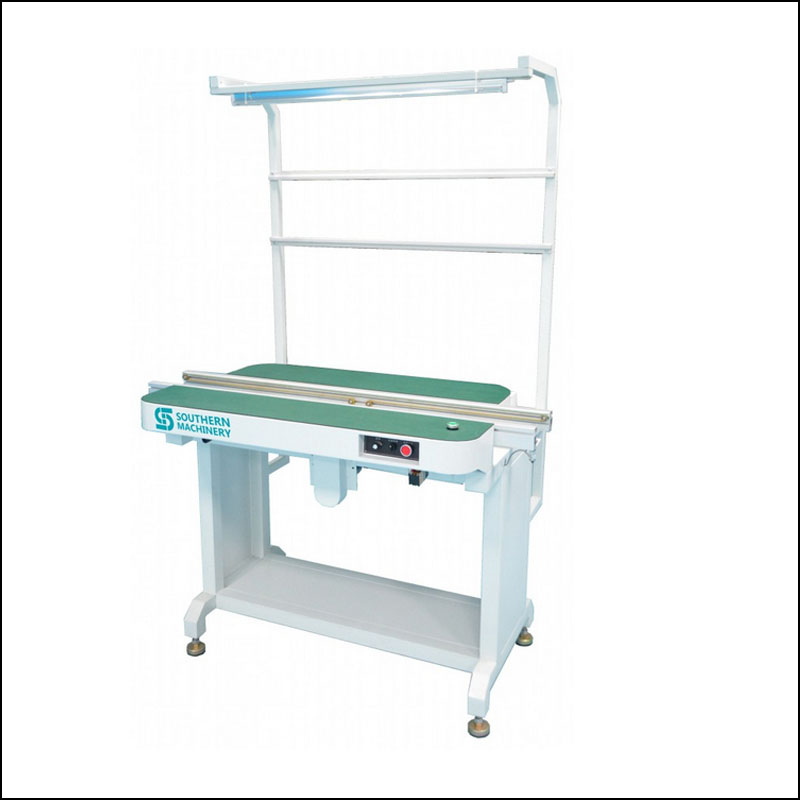
S-350C PCB Buffer Conveyor — bridges the gap between SMT outfeed and THT infeed
The invisible gap
A typical SMT line outputs boards at a steady, predictable rhythm. The Pick and Place runs at its programmed speed. The Reflow Oven maintains its profile. AOI inspects every board. Then the boards come out — and what happens next?
In many factories, they go into a tote box. An operator walks them to the next station. Another operator unloads them, orients them, and feeds them into the Wave Soldering or selective soldering machine.
This handoff is rarely tracked on any production report. No dashboard shows the time a PCB spends in a tote box or the labor minutes spent transferring boards between SMT and THT. But those minutes add up — and they affect the entire line's effective throughput.
From personal observation of multi-line EMS operations, this gap is worth checking. Not every factory has it. High-volume, single-product lines with dedicated conveyors between processes typically do not. But in factories running mixed products, frequent changeovers, or separate SMT and THT departments, the gap can be significant.
Three hidden costs nobody tracks
When boards sit in a tote box or move through manual transfer, three invisible costs accumulate.
ESD risk. Every time a PCB is picked up by hand, it acquires a new ESD exposure path. Boards in tote boxes slide against each other during transport. The cumulative ESD risk across dozens of boards per shift can be higher than what standard ESD audits capture — because audits often focus on workstations and wrist straps, not on in-transit container handling.
Ergonomic cost. Operators who transfer PCBs between lines spend their shifts bending, lifting, flipping, and carrying. This is repetitive physical work. It drives turnover, and it introduces variability — every operator transfers boards at a slightly different pace, with a slightly different orientation, with a slightly different level of care.
Throughput loss. The SMT line does not stop when the tote box is full. But the THT line stops when it has no boards. In a manual transfer setup, the buffer between the two lines is whatever the operator can carry. When the operator is walking, neither line is running at its potential.
These three costs — ESD, ergonomics, throughput — exist on a spectrum. A factory running 500 boards per shift with a single SMT-to-THT transition may not feel them. A factory running 5,000 boards across four lines almost certainly does.
How automated board handling changes the flow
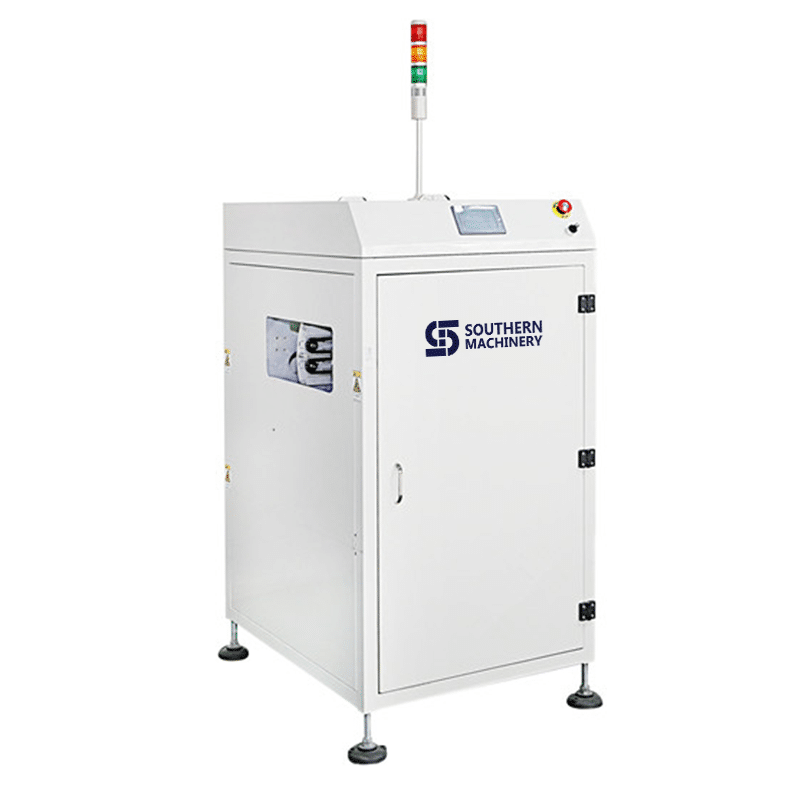
PCB Invertor/Flipper — eliminates manual flipping between processes
The alternative is not a radical re-engineering of the entire line. It is a set of modular, standardized board handling components that bridge the gap between process steps.
A Buffer Conveyor sits between the SMT outfeed and the THT infeed. It absorbs the pace difference between an asynchronous SMT line (which outputs boards one at a time at variable intervals) and a synchronous THT process (which feeds boards at a fixed pitch). The buffer gives the THT line a steady supply without requiring the SMT line to slow down.
A PCB Invertor handles the common need to flip boards between processes. Double-sided PCBs coming out of Reflow Oven may need to enter Wave Soldering upside-down. Manual flipping takes about two seconds per board — but across 500 boards, that is nearly 17 minutes of non-value-added labor per batch. Every manual flip also carries a risk of dropped boards or misorientation.
A Destacker or Loader replaces manual magazine unloading at the start of the THT line. Instead of an operator pulling boards one by one from a magazine, the machine feeds them automatically.
The key enabler behind all of this is SMEMA compatibility. SMEMA (Surface Mount Equipment Manufacturers Association) is a widely adopted interface standard that allows board handling equipment from different manufacturers to communicate with each other. A Buffer Conveyor from one supplier can talk to a Pick and Place from another. A Destacker can feed into a Wave Soldering machine from a third. SMEMA is not a brand lock-in — it is an interoperability guarantee.
Board handling equipment from Southern Machinery, for example, is SMEMA-compliant across its full line: the S-350C PCB Buffer Conveyor, SUL-390 Magazine Unloader, SLC460 Destacker/Loader, S-H407 High-end Conveyor with antistatic belt and stainless steel construction, standard PCB Conveyors in 500/1000/1200/2000mm lengths, and PCB Invertor/Flipper. All PLC-controlled, all CE-certified. But the point here is not the specific product list — it is that SMEMA-compliant board handling acts as a plug-and-play addition to any existing line, regardless of who made the main equipment.
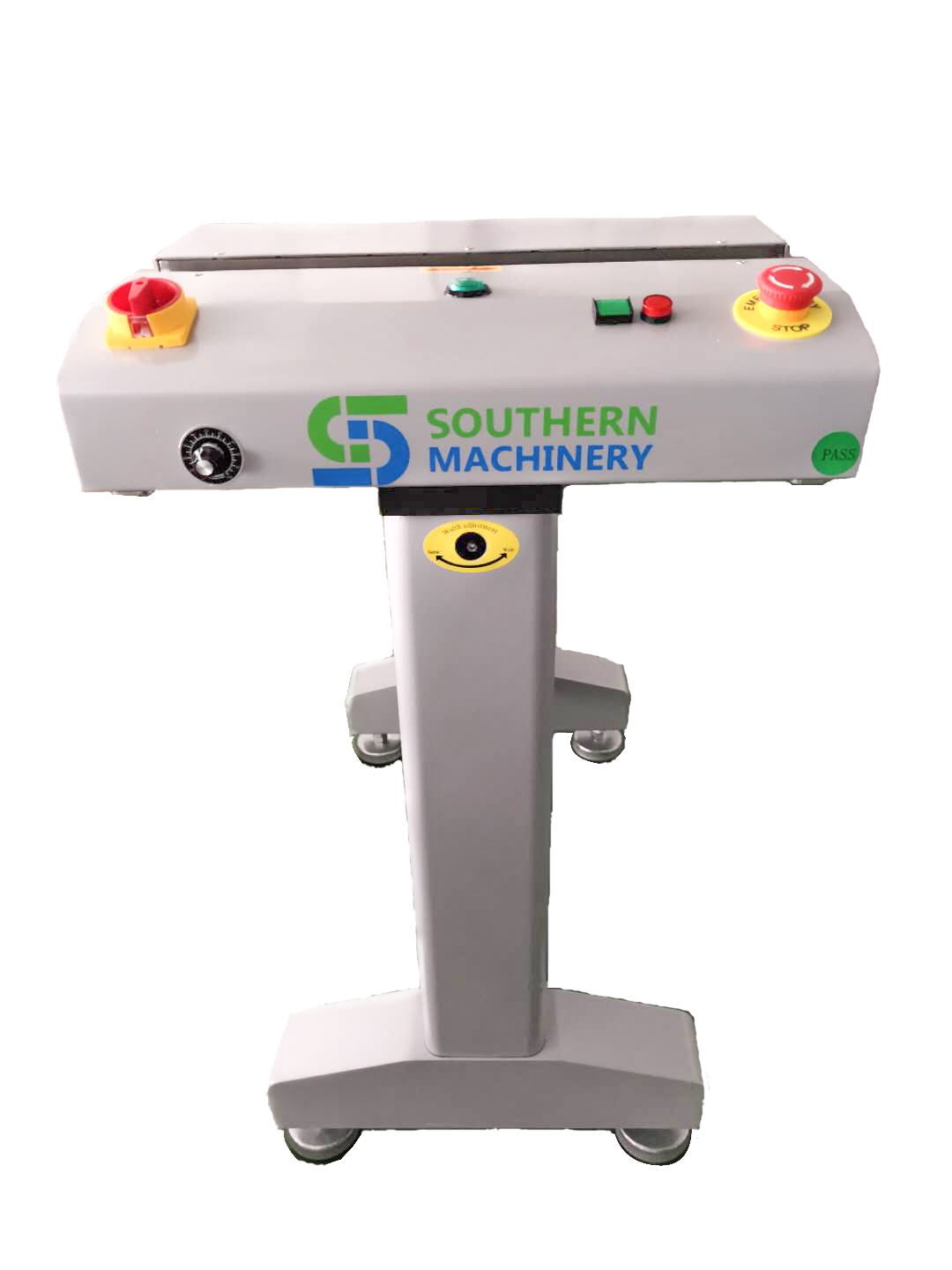
S-H407 High-end Conveyor — antistatic belt, stainless steel, SMEMA-compatible
The retrofit question
A common concern: "Can I add board handling to my existing line without replacing my Pick and Place or Wave Soldering machines?"
For most lines, the answer is yes — provided the existing equipment supports SMEMA signaling. Most equipment manufactured in the last 15 years does. Board handling equipment sits inline, between existing machines, without modifying them. The conveyor height, board width, and signaling protocol are standardized enough that retrofit is typically a same-day installation.
The economic logic is straightforward. Adding a Buffer Conveyor involves a fraction of the capital expenditure of replacing a Pick and Place. The immediate effect is a reduction in manual labor at the transition point — one operator freed from transfer work per shift. If that operator can be redeployed to a value-adding role, the cost justification becomes clear.
However, this applies most directly to factories that currently use manual transfer between process steps. If your line already has integrated conveyors from the Pick and Place to the Wave Soldering machine, adding more board handling equipment may not produce the same benefit.
A simple audit
Here is a five-minute exercise that costs nothing and produces immediate insight.
Walk to the transition point between your SMT outfeed and your THT infeed. Stand there for 10 minutes. Count:
- How many PCBs are sitting in tote boxes right now?
- How many operators are involved in moving boards between these two process steps?
- How long does it take from the moment a board exits the last SMT machine to the moment it enters the first THT machine?
If the answer surprises you, you have found an opportunity. If the gap is already zero — boards moving directly from one process to the next with no manual intervention — then your line is already running at its potential in this dimension.
Most factories I have observed fall somewhere in between. The gap exists, it is measurable, and it is fixable with standard, SMEMA-compatible components that can be added to an existing line in a single day. Some examples include SMEMA-compliant equipment from suppliers like Southern Machinery, but the key requirement is compatibility — not a specific brand.
The bottleneck in your line may not be where you think it is. Sometimes, the slowest part is not a machine — it is the space between them.
Download ResourceDownload Board Handling ROI Calculator (PDF)