
Board Handling Is Just Passive Conveyors -- and Other Beliefs That Create Hidden Bottlenecks
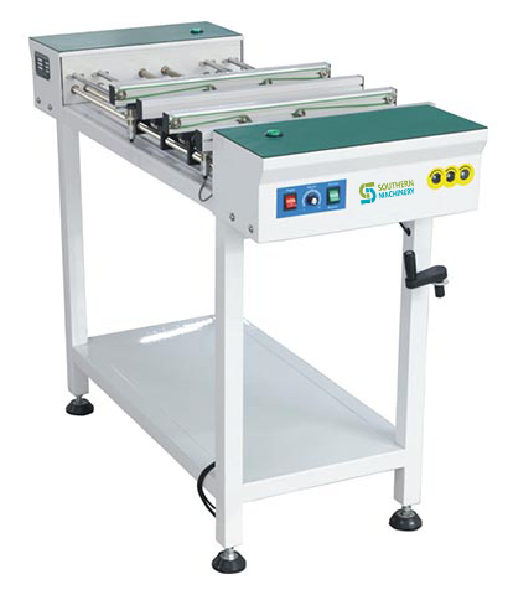
Automated PCB conveyor line connecting SMT and THT process stations
Every SMT production line has a moment that nobody logs. The Pick and Place finishes its last board, and an operator walks over, picks up a stack of PCBs by hand, and carries them to the next station. It takes fifteen seconds. It happens once an hour. Nobody reports it on the OEE dashboard. Yet that fifteen-second gap, repeated across every shift, adds up to a measurable fraction of lost throughput that most factories discover only when they start looking.
Automated PCB conveyor line connecting SMT and THT process stations
The paradox is this: factories invest heavily in high-speed Pick and Place machines and Reflow Oven profiling, then treat the infrastructure connecting them as passive conveyor track. Board handling determines how smoothly the entire line breathes. It is the circulatory system, not just the pipe. When it is underinvested, the whole line compensates in ways invisible to standard production reports.
I have walked through enough EMS factories to recognize the pattern. When I ask what happens between the last machine and the next, the answer usually involves an operator, a tote box, and a walk of several steps. That gap never appears on a dashboard, but it appears in every throughput number that falls short.
This article covers three beliefs about board handling, what they cost, and what the equipment does when specified correctly.
Belief 1: Conveyors just pass boards through
In many factories, a conveyor section is treated as a straight pass-through. As long as the belt turns, the line works.
What this misses is the difference between passing a board and buffering a line. The Pick and Place runs at a steady cadence. A downstream machine may pause for thirty seconds or two minutes -- a reel change, a nozzle clean, an operator break. Without buffer capacity between stations, that brief pause propagates upstream within seconds. The Pick and Place sits idle. Those micro-stops, each too short to trigger a formal downtime report, accumulate into a measurable OEE loss over a full shift.
The conveyor moves boards perfectly. The problem is that there is nowhere to store them when the next machine cannot accept them.
Belief 2: Manual transfer is fine for our volume
Each manual pickup takes three to five seconds of unproductive handling. But the time cost is only part of it. Every time an operator touches a PCB, there is an ESD exposure event. A populated board coming out of Reflow carries thousands of dollars of components. A static discharge at the wrong moment can degrade a MOSFET or an IC in a way that in-circuit test misses but field failure finds weeks later.
An operator walking across a factory floor and touching a board can deliver hundreds of volts of static. The antistatic belts on purpose-built board handling equipment dissipate charge continuously, with surface resistance held deliberately low. That difference -- between a belt that dissipates static and a hand that delivers it -- is the difference between a line that controls ESD risk and one that gambles.
Beyond ESD, manual handling introduces positioning variability. A board placed by hand may sit slightly crooked, causing a downstream machine to reject it. A machine places the board at the correct position and angle every time. That consistency shows up in first-pass yield, not in CPH.
Belief 3: One conveyor is the same as another
If you have bought conveyor sections from several vendors, you have likely encountered SMEMA handshake incompatibility. One machine's ready signal does not match another's timing. The line stops. The operator resets it. It happens again an hour later.
This is where specifications differ meaningfully. A conveyor with a standard SMEMA 4-pin interface and optical isolation handles handshake reliably across brands. A conveyor with motorized rail adjustment responds to a width change command in seconds instead of requiring a wrench. A conveyor with an ESD-safe polyurethane belt and stainless steel frame holds its properties for years where a budget alternative may degrade.
The S-H407 High-End Conveyor is built around these criteria. Its SUS304 stainless steel frame provides long-term dimensional stability. Its antistatic belt holds surface resistance under the dissipation threshold. Its PLC-based control integrates via the SMEMA interface, and its motorized width adjustment handles product changeover without operator intervention.
The difference between a generic conveyor and one designed for this environment becomes visible over a year of production, during changeovers, maintenance, and recovery from a stop.
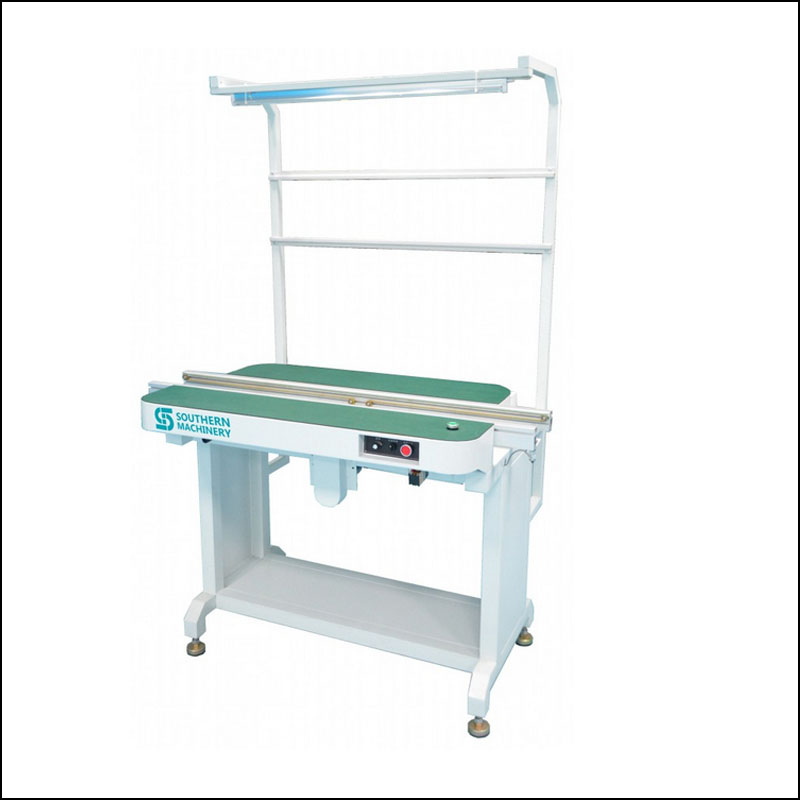 S-350C PCB Buffer Conveyor - stores up to 20 PCBs for line balancing
What board handling actually does
Once the three beliefs are set aside, board handling equipment becomes visible as an active line-balancing function with several roles. Southern Machinery's board handling range provides specific examples at each function level.
The first role is buffering. The S-350C Buffer Conveyor stores up to twenty PCBs to absorb speed differences between machines. Its conveyor speed ranges from 0.5 to 20 meters per minute, and its ESD-safe antistatic belt protects sensitive components. The SMEMA interface communicates with upstream and downstream equipment automatically. When a downstream machine pauses, the upstream machine continues filling the buffer. When the downstream machine resumes, the buffer releases accumulated boards. The line never stops.
The second role is automatic loading. The SLC460 Destacker separates individual PCBs from a stack and feeds them onto the line. It uses air jet nozzles to separate boards gently -- critical for thin or flexible PCBs -- and vacuum pickup to transfer each board without scratching. It handles boards up to 460 millimeters wide, processes up to ten PCBs per minute, and features motorized width adjustment.
The third role is magazine feeding. The SUL-390 Magazine Unloader feeds PCBs from standard SMT magazines with automatic elevation control, pushing each board onto the conveyor at the correct height. It stacks empty magazines automatically and uses SMEMA handshake to synchronize with downstream equipment. This replaces an operator who would otherwise remove boards from a magazine by hand.
The fourth role is board orientation. The PCB Invertor/Flipper rotates a board 180 degrees for dual-side processing. It uses soft edge grippers to hold the board without dislodging components, completes a rotation in under three seconds, and supports boards from 50 to 350 millimeters wide. After Wave Soldering, a board may need to be flipped for bottom-side inspection or a second Pick and Place pass. With an inverter, that flip happens without operator involvement.
The fifth role is high-end transfer. The S-H407 Conveyor, with its antistatic stainless steel frame and PLC control, serves as the backbone for lines where ESD sensitivity and reliability are critical. Its motorized width adjustment, standard SMEMA interface, and modular lengths make it adaptable to varied layouts.
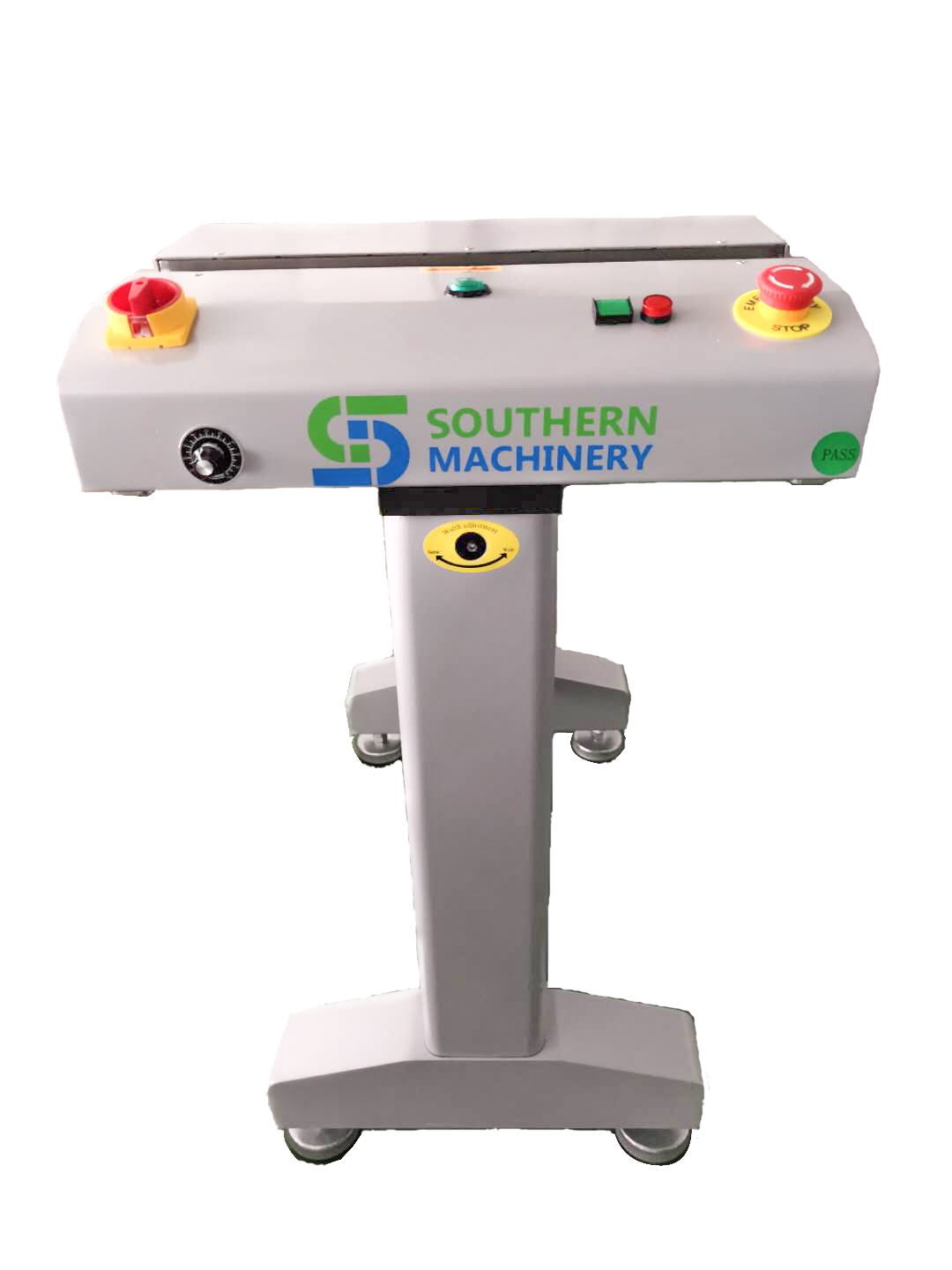 S-H407 High-End Conveyor with antistatic belt and PLC control
When board handling matters most
Board handling matters most when a line has three or more process steps. More machines in series means more opportunity for speed mismatch and more value from a buffer. It matters when the factory runs multiple product sizes across the same line, because motorized width adjustment saves hours of changeover time per week. It matters when PCBs are thin or flexible, because manual handling damage is higher with delicate substrates.
It matters less for single-process lines with dedicated operators and very low throughput. If the line has one machine and the operator is always present, the gap between automated and manual handling narrows.
The retrofit logic is straightforward. A buffer conveyor costs a small fraction of a Pick and Place. Adding one does not require replacing existing equipment -- only floor space, a power connection, and a SMEMA cable. The benefit begins on the first shift after installation.
This is not about fixing machine faults. It is about fixing the gap between machines that are otherwise running correctly. If the Pick and Place is running at full speed and the line still loses throughput to starvation, board handling is almost certainly the cause.
A five-minute line audit
A practical way to test whether board handling is a hidden bottleneck is to walk your line and check five signals. No MES data needed. No spreadsheets. Just five minutes of observation.
First, count how many boards are sitting between each pair of stations. If the number is consistently zero or one, there is no buffer capacity. A target of three to five boards indicates the line can absorb brief downstream pauses.
Second, count how many times an operator picks up a board by hand between stations in five minutes. If more than zero, there is a manual handling point carrying ESD risk and unproductive time. The target is zero.
Third, verify that every conveyor section is SMEMA-connected. A conveyor running without handshake may push boards into a machine that is not ready, causing a jam.
Fourth, watch during a changeover. Does anyone bend, reach, or stretch to access a conveyor rail or a board? Awkward postures add handling time and ergonomic cost.
Fifth, ask: if the conveyor at any point stopped right now, how long until the upstream machine also stops? If under sixty seconds, the line has no buffer depth. A target of five minutes or more means the line can ride through maintenance pauses without propagating downtime.
These five checks take under ten minutes, they cost nothing, and they reveal where the gap between your machines is costing you throughput that no machine upgrade can recover. The gap between your Pick and Place and your Reflow Oven, between your printer and your placement machine -- that gap is where a measurable fraction of your line's potential sits unused. Not because the machines are slow. Because the infrastructure connecting them was designed to pass boards, not to manage flow.
Board handling is not just conveyors. It is flow management. Treating it as passive infrastructure means leaving that flow unmanaged.