
How a Power Supply EMS Cut 6 Manual Stations to 2 While Keeping Output Flat
How a Power Supply EMS Cut 6 Manual Stations to 2 While Keeping Output Flat
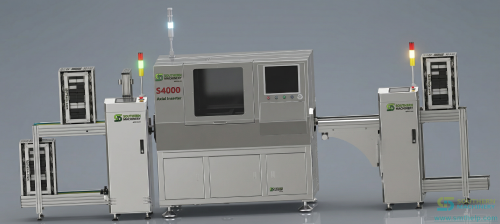
A power supply EMS factory in Shenzhen ran six manual insertion stations per shift, two shifts per day. Each PCBA carried 42 THT components — a mix of axial resistors, radial capacitors, LEDs, diodes, and a handful of odd-form transformers. The line had been running this way for three years. It was considered "stable."
What nobody had quantified was the gap between what the line cost and what it should cost.
The Real Cost of Manual THT Insertion
Manual insertion looks cheap on paper. One operator costs roughly 5,000-7,000 RMB per month in Shenzhen. Six operators per shift, two shifts — that is 60,000-84,000 RMB per month in direct labor. Approximately 720,000 to 1,008,000 RMB per year just for the THT insertion stations.
But that is only the visible cost.
The hidden costs emerge at AOI, after Wave Soldering. In this factory, the post-Wave Soldering AOI defect rate for THT-related defects was 3.8%. Each rework cycle consumed roughly 15 minutes per board. At 3.8% on a 2,000-board daily run, that is 76 boards per day needing rework — 19 hours of rework labor daily.
Manual insertion operators rotate every 4-6 months in Shenzhen. A new hire runs at 50% speed for the first two weeks. A skilled operator inserts 300-600 CPH. At 42 components per board, six operators yield about 50 boards per hour — 400 boards per 8-hour shift.
What Changes When Auto Insertion Enters the Line
Both the S4000 Axial Auto Insertion Machine and the S-3010B Radial Insertion Machine are standalone units that integrate into an existing THT production flow.
The S4000 handles axial lead components at 20,000 CPH. It supports up to 100 stations of component feeders and uses EtherCAT bus communication for real-time control. It is MES-ready.
The S-3010B handles radial components at 22,000 CPH theoretical (13,000 CPH sustained). It offers four-span insertion (2.5/5.0/7.5/10.0 mm), servo-driven head, and machine vision calibration at +/- 0.01mm accuracy. The clinch system bends leads to a controlled 10-35 degrees, 1.5-2.2 mm length.
Result: one S4000 handling 22 axial components, one S-3010B handling 16 radial components, two manual operators for odd-form. Six stations became two. Cycle time dropped to under 10 seconds per board versus 72 seconds manually.
When Auto Insertion Makes Sense
- 30+ THT components per board. Setup cost is amortized over many placements.
- Axial and radial are the majority. If 70% is odd-form, the S-70LD is the better starting point.
- At least one shift of continuous operation. Below 500 boards/month, manual may be better.
Wave Soldering, AOI, conveyors, and testing all remain unchanged.
The Staffing Exercise — Five Minutes
Walk your line and collect three numbers: operator count per shift, AOI defect rate for THT defects, and fully loaded rework cost per cycle.
Enter your actual numbers — see annual savings, headcount reduction, and ROI timeline
Download XLSX Calculator (Excel)Most Shenzhen EMS factories find the payback period between 8 and 14 months when replacing 4+ manual stations. Axial-dominant boards favor the S4000; radial-dominant boards favor the S-3010B.