
Is Your SMT Pick-and-Place Losing Vacuum? — Why Nozzle Cleaning Is the Most Overlooked Maintenance Step
Is Your SMT Pick-and-Place Losing Vacuum? — Why Nozzle Cleaning Is the Most Overlooked Maintenance Step
When an SMT Pick-and-Place line develops a sudden placement defect rate, the typical troubleshooting path follows a predictable sequence. Check the program offsets. Run a new calibration cycle. Inspect the Feeder alignment. Re-measure the board fiducials. The engineer may spend 2-3 hours cycling through these checks. In many cases, they find nothing visibly wrong.
Then someone checks the Nozzle vacuum.
A 40% drop from the rated spec. The cause is not visible to the naked eye. The Nozzle tip looks clean. The throat diameter appears clear. But inside the internal bore, flux residue from 8 hours of continuous production has accumulated in a thin, transparent film that reduces the suction force just enough to cause intermittent pick failures.
The fix: 15 minutes of Nozzle cleaning. No programming changes, no Feeder adjustments, no calibration cycles.

S-6200 Nozzle Cleaning Machine
The Hidden Cost of “Good Enough” Nozzles
In every Pick-and-Place head, the Nozzle is the final point of contact between the machine and the component. A new Nozzle typically delivers 95%+ vacuum retention at the tip. After one shift of continuous production, depending on the flux chemistry and the component mix, that vacuum can drop to 60-70%.
The consequences are subtle. The machine registers a false pick error — not a complete miss, but a slightly off-center pickup that the vision system compensates for. This adds a few milliseconds to each placement. Across 40,000 placements per hour, those milliseconds accumulate into measurable CPH loss.
More critically, a degraded vacuum causes:
- Component rotation during placement
- Increased tombstoning on small passives
- Skipped placements during high-speed sequencing
- Feeder retries that trigger upstream buffer gaps
Each of these defects either requires a rework station intervention or, worse, escapes to the next process stage. The cost is buried in rework labor, scrap PCBs, and delayed delivery timelines.
Why Visual Inspection Is Not Enough
Flux residue inside a Nozzle bore is often invisible in a quick visual check. The residue forms a clear or light-yellow film that clings to the internal walls without obstructing the throat opening. An engineer looks at the Nozzle, sees light passing through, and marks it as clean.
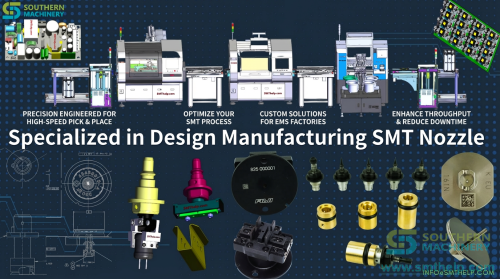
SMThelp Custom Nozzle Fabrication
The internal vacuum pathway is the problem. Even a thin residue film reduces the air seal between the Nozzle and the component surface. The rubber tip may look intact, but the actual holding force is a fraction of what it was at the start of the shift.
This is not a new problem. Every SMT line that runs lead-free or no-clean flux chemistries faces it. The question is whether the line has a systematic way to detect and correct it, or whether it waits until defects appear.
Automatic Nozzle Cleaning as a Maintenance Standard
The practical solution is to move Nozzle cleaning from a reactive activity to a scheduled maintenance step. Automatic Nozzle cleaning machines handle this in a repeatable cycle with controlled parameters.
One example is Southern Machinery's S-6200 Nozzle Cleaning Machine. It uses a combination of ultrasonic cavitation (40 kHz) and pressure flushing to remove residue from both the interior bore and the exterior surface of the Nozzle. The machine processes up to 30 Nozzles per cycle, with a cycle time of 10-20 minutes depending on residue level and Nozzle type.
The cleaning medium can be water-based or solvent, and the machine includes a dual-stage filtration system (10 micron + 0.5 micron) to extend solution life. The SUS304 stainless steel tank resists corrosion from aggressive flux chemistries. The compact benchtop design (500 x 400 x 600 mm) fits into the maintenance area of most SMT lines without requiring dedicated floor space.
For lines that run multiple machine brands — Panasonic, Fuji, Yamaha, Juki, ASM — a single S-6200 can service the entire Nozzle inventory.
Beyond Cleaning: When Nozzles Need Replacement
Cleaning restores vacuum performance, but Nozzles do have a finite service life. Rubber tips harden and lose compliance after repeated thermal cycling. Internal bore dimensions can change from mechanical wear in high-speed applications.

Custom Nozzle and Gripper
Here, a companion capability becomes relevant. Southern Machinery offers a custom Nozzle fabrication service where Nozzles are built to match OEM part numbers or customer-provided 3D models.
The economic logic is straightforward. A single Pick-and-Place head rebuild costs significantly more than replacing or refurbishing its Nozzle set. And a Nozzle cleaning machine — automatic, programmable, with documented cycle parameters — costs a fraction of either option.
Who Benefits Most from Scheduled Nozzle Cleaning
Lines that run 3 shifts per day will see the most immediate improvement. Low-volume or high-mix lines benefit differently — an automatic cleaning machine allows processing a batch of Nozzles between changeovers.
The 10-Second Vacuum Check Audit
Pick one Nozzle at start of shift. Measure its vacuum. After 8 hours, measure again. If vacuum dropped more than 15%, your line has Nozzle-related defects.
Download the SMT Nozzle Vacuum Check Worksheet — a printable template with reference vacuum ranges by machine brand.